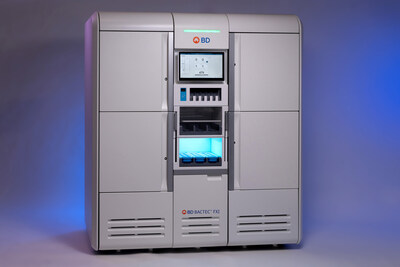
MILFORD, Mass., June 3, 2026 /PRNewswire/ -- Waters Corporation (NYSE: WAT) today announced that the BD BACTEC FXI Culture System has received U.S. Food and Drug Administration (FDA) 510(k) clearance. This clearance enables commercialization in the U.S. and provides a new option for laboratories seeking a fully automated blood culture system designed to improve the speed, consistency, and accuracy of sepsis and bloodstream infection diagnostics in modern microbiology laboratories.
Clinical study data¹ showed that the BD BACTEC FXI Culture System reduced mean time to detection by approximately three hours (~15%) compared with the previous-generation BD BACTEC™ FX Blood Culture System (17 hours vs. 20 hours). Faster detection enables earlier pathogen identification and more timely targeted antimicrobial therapy for patients with suspected bloodstream infections and sepsis. Because each hour of delayed sepsis treatment increases mortality by 3.6% to 9.9%,2 faster diagnostic workflows are critical in acute care settings.
"Recent evidence-based laboratory guidelines document the beneficial clinical impact of rapid laboratory results for the detection of bloodstream infections; therefore, advancing the science of automated blood culture instruments is critical to further speed results," said Donna M. Wolk, MHA, Ph.D., D(ABMM), Division Chief, Molecular and Microbial Diagnostics and Development, Geisinger Medical Laboratories. "Reducing the time to detection for positive results is key to improving the availability of Gram stain and other tests, on which treatment decisions are based. The faster, the better."
The BD BACTEC FXI Culture System features a first-of-its-kind capability in a blood culture platform – an automated gravimetric measurement of individual blood culture vial volume. By objectively confirming blood volume in each vial, the system reduces pre-analytical variability and supports more consistent diagnostics and adherence to recommended collection practices.
"Waters is proud to bring the BD BACTEC FXI Culture System to the U.S. market, delivering an important advancement in bloodstream infection diagnostics," said Jianqing Bennett, Senior Vice President, Waters Advanced Diagnostics, Waters Corporation. "This innovation reflects the scientific expertise and commitment of the Waters team to improve patient care. The system helps laboratories support earlier clinical decisions for patients with suspected sepsis and bloodstream infections when every hour matters."
Designed for high-throughput microbiology labs, the BD BACTEC FXI Culture System fully automates vial loading, unloading, incubation, and detection alerts, with an industry-leading automated loading capacity of up to 60 vials at a time,3 50% more vials than the leading competitior.4 Available in 480- and 960-vial configurations,3 the BD BACTEC FXI Culture System delivers scalable efficiency while reducing manual intervention and increasing staff walk-away time.
The BD BACTEC FXI Culture System was recently CE marked under the European Union's In Vitro Diagnostic Regulation (IVDR) and licensed by the Japan Pharmaceuticals and Medical Devices Agency (PMDA) for availability in Europe5 and Japan.6
Additional Resources:
The BD BACTEC FXI Culture System and BD BACTEC™ Blood Culture Vials are manufactured by Becton, Dickinson and Company or one of its affiliates or subsidiaries.
BD is a trademark of Becton, Dickinson and Company. Waters is a trademark of Waters Corporation or its affiliates. All other marks are the property of their respective owners.
About Waters Corporation:
Waters Corporation (NYSE: WAT) is a global leader in life sciences and diagnostics, dedicated to accelerating the benefits of pioneering science through analytical technologies, informatics, and service. With a focus on regulated, high-volume testing environments, our innovative portfolio harnesses deep scientific expertise across chemistry, physics, and biology. We collaborate with customers around the world to advance the release of effective, high-quality medicines, ensure the safety of food and water, and drive better patient outcomes by detecting diseases earlier, managing routine infections, and combating antibiotic resistance. Through a shared culture of relentless innovation, our passionate team of ~16,000 colleagues turn scientific challenges into breakthroughs that improve lives worldwide. For more information, please visit www.waters.com/aboutus.
Disclaimer:
The BD Biosciences and BD Diagnostic Solutions businesses have been acquired by Waters Corporation ("Waters"). Becton, Dickinson and Company or one of its affiliates or subsidiaries ("BD") remains the legal manufacturer of Biosciences and Diagnostic Solutions products until all required regulatory transfers are completed. During this interim period, BD maintains full responsibility for all regulatory obligations of the legal manufacturer. Product information provided here is supplied under BD's regulatory authority. To learn more about the relationship between Waters and BD during this transition period, please see our detailed summary: www.waters.com/bdtransaction.
References:
Contact:
Molly Gluck
Head of External Communications
Waters Corporation
508.498.9732
molly_gluck@waters.com

Photo - https://mma.prnewswire.com/media/2993851/BD_BACTEC_FXI_A__Waters_Corporation.jpg
Logo - https://mma.prnewswire.com/media/2071755/Waters_Corporation_Logo.jpg
 View original content:https://www.prnewswire.co.uk/news-releases/waters-announces-fda-510k-clearance-of-bd-bactec-fxi-culture-system-enabling-broader-access-to-bloodstream-infection-diagnostics-302789492.html

In der Debatte um die psychische Gesundheit von Kindern und Jugendlichen rücken österreichische Schulen zunehmend in den Fokus. Golli Marboe, Initiator der „Mental Health Days“, fordert, Lehrerinnen und Lehrer deutlich stärker zu unterstützen – und zugleich in die Pflicht zu nehmen. Im Gespräch mit der APA plädierte er dafür, dass alle Pädagoginnen und Pädagogen einmal im Jahr verpflichtend eine Fortbildung zu einem Thema rund um das psychische Wohlbefinden absolvieren. Zusätzlich brauche es ein strukturiertes Angebot zur regelmäßigen Supervision.
Marboe verweist darauf, dass der Lehrberuf damit eine Sonderrolle einnimmt: „Es ist der einzige Sozialberuf, der das nicht hat“, sagt er mit Blick auf fehlende Supervisionsstrukturen. Nach seiner Vorstellung sollen Lehrkräfte damit nicht nur entlastet, sondern auch besser befähigt werden, Warnsignale bei Schülerinnen und Schülern frühzeitig zu erkennen und professionell darauf zu reagieren. Die Forderung zielt auf eine langfristige Verankerung von Mental-Health-Kompetenz im Schulalltag ab.
Zusätzlichen Druck erzeugt aus Sicht von Fachleuten der Umgang Jugendlicher mit sozialen Medien. Barbara Haid, Präsidentin des Österreichischen Bundesverbands für Psychotherapie (ÖBVP), unterstützt ein Social-Media-Verbot für Unter-14-Jährige ausdrücklich. „Kinder brauchen keine sozialen Medien“, betont sie und spricht sich für einen altersgerechten, schrittweisen Zugang aus – ähnlich wie beim Führerschein, für den man lernen und eine Prüfung ablegen müsse. Besonders problematisch seien sogenannte „Endless Reels“, also endlos scrollbare Kurzvideo-Formate, die nach Einschätzung von Haid und Marboe stärkere Auswirkungen auf die Psyche haben können als klassische Textnachrichten, während Ängste gleichzeitig diffuser würden.
Dass viele Lehrkräfte im Bereich Social Media weniger sattelfest sind als ihre Schülerinnen und Schüler, sehen die beiden Experten nicht als Nachteil. Marboe zieht den Vergleich mit Suchtprävention: Man müsse „nicht jede Droge ausprobieren, um darüber reden zu können, dass Drogen schlecht sind“. Haid verweist auf Klassen, in denen sich Lehrende digitale Plattformen von den Jugendlichen erklären lassen. Diese bewusste Rollenumkehr könne die Beziehungsebene stärken, weil die Schülerinnen plötzlich als Expertinnen auftreten. Aus Sicht der Befürworter solcher Ansätze ist das Zusammenspiel aus besser geschulten Pädagoginnen, klareren Social-Media-Regeln und strukturierten Unterstützungsangeboten ein zentraler Baustein, um die mentale Gesundheit junger Menschen im Bildungssystem langfristig zu stabilisieren.