HEFEI, China, Oct. 21, 2026 /PRNewswire/ -- Sungrow, a globally leading PV inverter and energy storage system provider, announced that its latest PowerTitan 3.0 battery energy storage system (BESS) has successfully completed a large-scale fire test conducted in accordance with the latest applicable requirements of UL 9540A: 2026 and CSA/ANSI C800-2025, making it the industry's first stacked-cell BESS with an AC-block design to successfully complete such a test. From PowerTitan 1.0 to 3.0, all three generations passed the large-scale fire test on the first attempt.
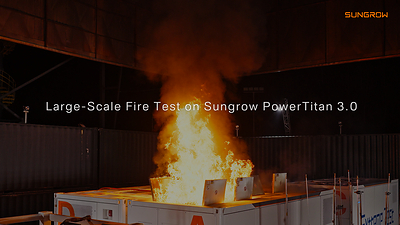
Conducted by UL Solutions, witnessed by Fire Risk Alliance (FRA), and observed by Jensen Hughes (JH), the test evaluated the system's ability to contain a severe thermal runaway event and prevent it from propagating to adjacent BESS containers and the Medium-Voltage Substation.
Tested Under Demanding Real-World Installation Conditions
The test setup replicated the block-level layout of a real-world utility-scale BESS installation, including 28.56 MWh of fully liquid-cooled PowerTitan 3.0 BESS and a 7.4 MW Medium-Voltage Substation (MVS). PowerTitan 3.0 features high-energy-density stacked cells and an integrated AC block architecture, combining the battery system and DC/AC Power Converter Unit within a single 20-foot container.
To further challenge the system's safety design, the BESS was at 100% state of charge. The initiating container and the adjacent container were installed back-to-back closely. The MVS was also included in the test configuration. All active fire suppression systems and thermal management system were disabled, and rooftop pressure-relief panels of the initiating container were also fully opened to maximize ventilation and oxygen availability. The test focused on the system's inherent ability to contain thermal runaway.
All smoke and fire effluent generated during the event were collected and routed through a dedicated purification system. The collected gases were fully treated, with no untreated smoke released directly into the environment.
Thermal Runaway Did Not Propagate
The test successfully demonstrated that thermal runaway did not propagate from the initiating BESS container to any adjacent containers or the MVS.
The test continued for 7.5 hours under uninterrupted monitoring. The peak internal temperature in the initiating container, identified as Container A, reached 1259.8°C, while the highest cell temperature in the adjacent containers well remained below the threshold for thermal runaway under UL 9540A: 2026.
Despite the intensity and duration of the fire, Container A remained structurally intact. Adjacent Containers B, C, D and E also remained structurally intact, with no deformation. Even after the fire test, the container remained structurally intact and could be lifted as a complete unit.
Under full-charge, close-spacing and maximum-ventilation conditions, the PowerTitan 3.0 contained the thermal event within the initiating container and prevented it from escalating into a multi-container event. The results demonstrate stable, reliable and controllable system performance under extreme conditions and mark a key step in validating the safety of higher-energy BESS platforms.
Three Generations. All Successfully Tested. Simulation Meets Reality.
From PowerTitan 1.0 and 2.0 to PowerTitan 3.0, all three generations have completed their large-scale fire tests on the first attempt, enabling Sungrow to build a comprehensive database of thermal runaway and fire behavior. Before the physical test, PowerTitan 3.0 underwent simulation-based assessments across hundreds of application scenarios and operating conditions using Sungrow's simulation platform, the world's largest of its kind. The simulated fire intensity and development trends closely matched those observed during the physical test, validating the model's ability to predict fire behavior under extreme conditions.
"This test was about verifying our safety design under real-world extreme conditions," said Roger Li, General Manager of the Utility-Scale Product Line, Sungrow Energy Storage Business Unit. "Safety must be engineered into the product from the beginning. Simulation helps predict how the system will respond, while large-scale fire testing puts those predictions to the test. Energy storage safety is about far more than cell safety alone. It is the result of multiple factors working together, including cell performance, system integration, thermal management, structural protection, engineering design, and more."
Benjamin Liu, Engineering Manager at UL Solutions, commented: "Sungrow started with safety by design, used pre-test assessments to predict fire behavior, and then validated those predictions through a large-scale fire test. The test result showed that the design was able to contain the fire and prevent propagation, helping significantly reduce the potential scale of loss."
By bringing together safety-by-design engineering, predictive simulation and large-scale physical testing, Sungrow is building a robust, evidence-based approach to BESS safety. For project owners, investors, insurers and emergency responders, this provides a stronger technical basis for assessing fire risks, planning emergency responses and protecting critical assets throughout a project's lifecycle.

 View original content to download multimedia:https://www.prnewswire.co.uk/news-releases/three-generations-all-first-time-passes-powertitan-3-0-validates-system-level-safety-under-extreme-large-scale-fire-test-302915315.html

Ein umfangreicher Auswertungsbericht der Wirtschafts- und Korruptionsstaatsanwaltschaft (WKStA) zu digitalen Daten des verstorbenen Justiz-Spitzenbeamten Christian Pilnacek sorgt für neuen politischen und justizinternen Sprengstoff. Chatprotokolle, E-Mails und weitere Unterlagen zeichnen ein Bild tiefgreifender Konflikte innerhalb der Justiz – insbesondere zwischen der WKStA und Teilen der vorgesetzten Behörden. Parallel dazu bereitet ein parlamentarischer Untersuchungsausschuss die Befragung von Schlüsselpersonen vor, um mögliche politische Einflussnahmen auf Ermittlungen rund um Pilnacek und dessen Tod zu beleuchten.
Aus der von der WKStA erstellten Expertise zu Pilnaceks Kommunikationsdaten geht hervor, wie der langjährige Leiter der für Strafrecht zuständigen Sektion im Justizministerium über Jahre hinweg gegenüber der WKStA Stellung bezog. Der Bericht zeigt, dass der damalige Wiener Oberstaatsanwaltschef Johann Fuchs im Juni 2019 in einer internen Nachricht erklärte, er sehe es als Aufgabe seiner Amtszeit, eine von der WKStA angeblich offengelegte „Verkommenheit“ im Berufsstand „mit allen Mitteln zu bekämpfen“. Er bezeichnete Pilnacek darin ausdrücklich als Mitstreiter. In dem Gutachten findet sich zudem Material, aus dem hervorgehen soll, wie die Korruptionsstaatsanwaltschaft aufgelöst und neu aufgesetzt werden könnte.
Die Auswertung des Laptops und mehrerer Speichermedien Pilnaceks, die in einem rund 440 Seiten starken Bericht zusammengefasst wurde, behandelt auch seine Kontakte in das Umfeld der ÖVP. Der frühere Sektionschef war von 2010 bis 2020 über alle wesentlichen Strafsachen der Republik informiert und konnte als weisungsbefugter Beamter Ermittlungsschritte mitsteuern oder Berichte anfordern. Laut dem Bericht kooperierte er in dieser Zeit eng mit ÖVP-nahen Personen und wirkte an der Verteidigung von Beschuldigten mit. Nach Bekanntwerden einer Audioaufnahme aus dem Sommer 2023, in der Pilnacek Interventionen von ÖVP-Seite beklagte, leitete die WKStA ein Ermittlungsverfahren gegen unbekannte Täter ein; dieser Interventionsakt ist nun ebenfalls Gegenstand des U-Ausschusses.
Der Untersuchungsausschuss, der sich mit den Umständen von Pilnaceks Tod und dem Umgang der Behörden befasst, bekommt das WKStA-Dokument zeitlich passend zur nächsten Befragungsrunde vorgelegt. Zunächst soll ein IT-Experte der WKStA, der für das Auslesen von Datenträgern zuständig ist, Auskunft geben. In den darauffolgenden Tagen werden Exekutivbeamte befragt, darunter der Leiter des Bundeskriminalamts sowie zwei Polizeibeamte aus Niederösterreich, die unter anderem mit Pilnaceks Geisterfahrt Stunden vor dem Fund seiner Leiche in einem Donau-Seitenarm befasst waren. Politisch besonders im Fokus steht der Auftritt von Innenminister Gerhard Karner und dessen Kabinettschefin, nachdem eine vom Ressort in Auftrag gegebene Schulungsunterlage für geladene Auskunftspersonen parteiübergreifend – mit Ausnahme der ÖVP – auf Kritik gestoßen war.
Die Kombination aus internen Justizchats, detaillierter Datenauswertung und politischer Aufarbeitung im Parlament verschärft die Debatte über das Verhältnis zwischen Ministerien, Staatsanwaltschaften und Parteien. Während die WKStA ihre Auswertungsergebnisse in den U-Ausschuss einbringt, suchen Abgeordnete nach Antworten auf die Frage, ob und in welchem Ausmaß versucht wurde, auf Ermittlungen Einfluss zu nehmen – sowohl in prominenten Wirtschafts- und Korruptionsfällen als auch im Zusammenhang mit den Untersuchungen nach dem Tod eines der einflussreichsten Justizbeamten der vergangenen Jahre.