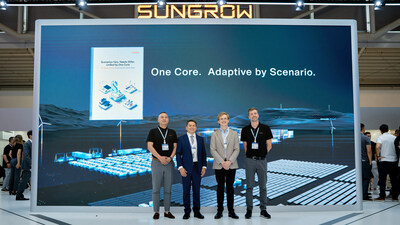
MUNICH, June 24, 2026 /PRNewswire/ -- Sungrow, the globally leading PV inverter and energy storage system provider, released its S+ Energy Storage Multi-Scenario White Paper at Intersolar Europe 2026. The white paper introduces a new framework to address the industry's most pressing challenges: delivering energy storage solutions that truly meet the diverse and evolving demands of real-world applications.
Energy Storage Moves Beyond One-Size-Fits-All
As energy storage is deployed across more applications, scenario differences are becoming more fundamental. Use cases such as renewable energy bases, AI data centers, PV-storage-charging stations, zero-carbon industrial parks, and off-grid microgrids each require distinctly different system capabilities and value priorities.
Even within generation-side storage, the logic can vary significantly. Renewable energy integration often requires longer-duration shifting, while grid-forming applications demand fast response and enhanced stability support. Emerging applications such as green hydrogen production further depend on tight coordination among power generation, storage, and electrolyzers.
These differences are no longer only about capacity, power rating, or duration. They reflect different operating conditions, grid constraints, and value objectives. The White Paper states that the era of using one standardized product to serve all scenarios is coming to an end.
The industry has widely discussed "scenario + energy storage," yet many solutions still follow a product-led approach — applying standardized systems to diverse projects, or relying on on-site hardware assembly and temporary tuning. Such models may enable deployment, but often struggle to match real project requirements or deliver long-term value.
"S+": Scenario, Synergy, Sustain
Sungrow's answer is embodied in the name S+, standing for Scenario, Synergy, and Sustain: scenario-defined solutions, native system synergy, and sustained value delivery. The White Paper calls for a shift from "applying products to scenarios" to "defining solutions by scenarios." True scenario-based design does not imply building every system from scratch; rather, it relies on a robust and reusable technological foundation to quickly configure the best solutions for different scenarios.
This approach reflects three core shifts:
A Unified Foundation for Diverse Scenarios
At the heart of S+ is a set of cross-scenario, reusable foundational capabilities, built on what Sungrow calls the "S+ Dual-Engine Foundation":
In essence, Sungrow uses the certainty of its foundation to offset the uncertainty of scenarios.
This capability is underpinned by nearly 30 years of expertise in the industry, over 1,000 GW of global engineering experience, and full-chain in-house R&D across wind, PV, storage, EV charging, hydrogen, and AI data center applications.
"With every stage connected, Sungrow has formed a chain of capabilities: insight defines needs, configuration generates solutions, simulation validates feasibility, R&D realizes designs, manufacturing ensures consistency, testing safeguards quality, operation delivers returns, and maintenance secures performance," said Dr. Cai Zhuang, General Manager of the Product Business Center at Sungrow Energy Storage Business Unit.
With S+, Sungrow delivers not a single storage system, but sustainable value designed for the uncertain scenarios of today and tomorrow. The S+ Energy Storage Multi-Scenario White Paper is now available on the company's official website. Please click the link: https://official-overseas-www.sungrowpower.com/en/white-paper
Contact:
Sungrow
Scarlett Rong
rongtianjiao@sungrowpower.com
Photo - https://mma.prnewswire.com/media/2999483/image1.jpg
Logo - https://mma.prnewswire.com/media/1344575/Logo.jpg
 View original content:https://www.prnewswire.co.uk/news-releases/sungrow-releases-s-energy-storage-multi-scenario-white-paper-302808845.html

Bei der Verleihung des BRICK AWARD 26 in Wien hat ein vietnamesisches Projekt den Ton für die internationale Ziegelarchitektur vorgegeben: Der Đạo Mẫu-Tempel mit angeschlossenem Museum wurde mit dem Grand Prize ausgezeichnet. Das Gebäude, das laut Veranstalter CO2-negativ errichtet wurde, setzt auf lokale Tonziegel und gilt als besonders ressourcenschonend. Die Gala in der österreichischen Hauptstadt zeigte, wie weit das Spektrum zeitgenössischer Keramikarchitektur inzwischen reicht – von religiösen Stätten in Asien bis zu Industrieanlagen in Lateinamerika.
Der BRICK AWARD wird seit 2004 alle zwei Jahre vergeben und versteht sich als herstellerunabhängige Plattform für Architekturbüros, die mit Ziegeln und Keramik arbeiten. Ausrichter ist der Baustoffkonzern Wienerberger, der mit dem Preis ein internationales Netzwerk von Pionieren der Ziegelarchitektur bündelt. Prämiert wird in fünf Kategorien: „Feeling at home“ für Einfamilienhäuser und kleinere Projekte, „Living together“ für städtische Wohnanlagen, „Working together“ für Gewerbe- und Industriebauten, „Sharing public spaces“ für öffentliche Gebäude und Räume sowie „Building outside the box“ für besonders innovative Ansätze.
Auf der Ebene der Einzelkategorien spiegelten die diesjährigen Gewinner zentrale Branchentrends wider. In der Kategorie „Feeling at home“ wurde ein offenes Einfamilienhaus auf Mallorca ausgezeichnet, das mithilfe speziell gesetzter Wände den Meerblick maximiert und zugleich Privatsphäre schafft. „Living together“ entschied ein gemischt genutztes Gebäude in Barcelona für sich, das nachhaltige Ziegel mit einem sozialen Innenhof kombiniert und damit auf dichte, aber gemeinschaftlich orientierte Stadtentwicklung setzt. In „Working together“ ging die Auszeichnung an ein Lager- und Bürogebäude in Mexiko, das lokale Keramik und vulkanisches Material integriert und so industrielle Nutzung und regionale Baustoffe verbindet.
Erstmals vergab die Jury zusätzlich einen Sonderpreis für innovatives gemeinschaftliches Wohnen. Dieser ging an ein Projekt in Belgien, das wiederverwendete Ziegel einsetzt, um eine nachhaltige Nachbarschaft zu schaffen. Der Fokus auf Recycling, CO2-Reduktion und lokale Materialien zieht sich damit durch zentrale Gewinnerprojekte des BRICK AWARD 26. Für Wienerberger, dessen Aktie zum Zeitpunkt der Meldung bei 22,71 Euro notierte, schärft die Auszeichnung zugleich das Profil als global vernetzter Akteur im Bereich Ziegel- und Keramiklösungen – mit dem nächsten Termin im Finanzkalender, der Quartalsmitteilung am 12. August 2026, bereits in Sichtweite.