MUNICH, July 13, 2026 /PRNewswire/ -- During the Intersolar Europe 2026 exhibition, Sungrow and TÜV Rheinland jointly launched the world's first quantitative long-term reliability standards for PV inverters, including 2 PfG 3325 Reliability test qualification for IGBT modules in photovoltaic power systems and power electronic converter systems and 2 PfG 3328 - Part 2 Specifications for Reliability Testing and Assessment of Power Electronic Products - Part 2: Power Conversion Equipment (PCE).
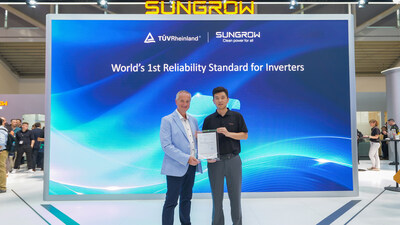
Sungrow's SG510HX string inverter and its IGBT modules were among the first products certified under the two standards, providing early validation of the framework in practical applications.
Meeting the Demands of Modern PV Plants
As PV power plants continue to expand into increasingly demanding environments such as deserts, offshore locations, and high-altitude regions, ensuring inverter reliability over 25 years of operation has become increasingly important for project owners and investors. However, existing reliability qualification methodologies were not originally designed to fully capture the increasingly diverse and demanding operating conditions of modern PV plants, creating a gap between laboratory qualification and long-term field performance.
To address this challenge, Sungrow and TÜV Rheinland have developed a comprehensive reliability evaluation framework that enables a more scientific, quantitative, and traceable assessment of inverter lifetime performance.
From Systems to Components: A Unified Reliability Validation Framework
Facing the shortcomings of traditional standards, the dual framework establishes a robust, quantifiable reliability methodology spanning the entire "system-component" validation continuum.
Together, the standards establish a system-to-component validation chain: 2 PfG 3325 provides a quantitative data basis for inverter -level reliability modeling and supplier evaluation, while 2 PfG 3328 - Part 2 defines a unified inverter -level validation framework with testable and traceable criteria.
New Standards Upgraded for Complex Scenarios
Addressing the issue of insufficient coverage in traditional standard scenarios, the standards added several enhanced test items designed for complex operating conditions.
The standards significantly strengthen reliability verification by expanding test coverage for complex operating scenarios.
Quantifiable Lifetime Assessment
To improve the quantitative assessment of long-term field reliability, the standards establish data-driven lifetime models based on extensive field performance data from PV power plants. The standards also draw on automotive components' reliability testing and quality verification standards such as VW 80000 and GMW 3172, adopting more stringent test approaches to evaluate long-term stability under complex operating conditions.
"The two standards establish a structured and verifiable framework for long-term inverter reliability evaluation, offering valuable references for manufacturers, investors, and insurers in assessing lifecycle performance," said Thomas Haupt, Vice President of Solar & Commercial Products, European Region of TÜV Rheinland Group.
Why Sungrow
As the pioneering architect of these standards, Sungrow leveraged its 29 years of expertise in power electronics together with extensive global project experience and operational insights across diverse climates and applications. Steering the reliability evaluation of PV inverters away from subjective empirical deductions toward a scientifically quantifiable, verifiable, and traceable future.
Photo - https://mma.prnewswire.com/media/3005616/111.jpg
Logo - https://mma.prnewswire.com/media/1344575/Logo.jpg
 View original content:https://www.prnewswire.co.uk/news-releases/sungrow-and-tuv-rheinland-redefine-industry-rule-worlds-first-inverter-long-term-reliability-corporate-standards-released-302823493.html

Die Wolftank Group hat auf ihrer ordentlichen Hauptversammlung am 12. Juni 2026 den Kurs für die nächsten Jahre abgesteckt und zugleich die Kapitalmarktkompetenz im Aufsichtsrat ausgebaut. Die Aktionäre des auf Umwelttechnologien und emissionsfreie Infrastrukturlösungen spezialisierten Unternehmens stimmten allen zur Beschlussfassung vorgelegten Tagesordnungspunkten zu. Zentrale Themen waren die Präsentation des Jahresergebnisses 2025, die neue Wachstumsstrategie „GreenLead 2030“ sowie eine Satzungsänderung zur Erweiterung des Aufsichtsrats.
Mit „GreenLead 2030“ peilt die Wolftank Group nach Unternehmensangaben einen Umsatz von 250 Millionen Euro und eine EBITDA-Marge von zwölf Prozent an. Nach der Vorstellung der Ergebnisse für 2025 folgte die Hauptversammlung dem Vorschlag des Vorstands, den im Jahresabschluss zum 31. Dezember 2025 ausgewiesenen Bilanzverlust auf neue Rechnung vorzutragen. Zugleich wurden Vorstand und Aufsichtsrat für das abgelaufene Geschäftsjahr entlastet, was als Vertrauensbeweis der Aktionäre in die Unternehmensführung gewertet werden kann.
Strukturell stellte Wolftank die Weichen über eine Satzungsänderung, mit der die Höchstzahl der Aufsichtsratsmitglieder von fünf auf sechs angehoben wurde. Neben den bisherigen Mitgliedern Dr. Andreas Aufschnaiter (Vorsitz), Dr. Peter Podesser (stellvertretender Vorsitz), Dr. Peter Werth, David Hofmann und Raphaela Lindlbauer wurde erstmals Marcel Maschmeyer in das Kontrollgremium gewählt. Damit wird das Gremium um eine zusätzliche Stimme mit ausgewiesener Expertise im Investment- und Kapitalmarktbereich ergänzt.
Maschmeyer ist Vorstand der Paladin Langfrist KGaA und Geschäftsführer der Paladin Invest GmbH. Das auf börsennotierte Small- und Mid-Cap-Unternehmen spezialisierte Investmenthaus Paladin hat sein Engagement bei der Wolftank Group im vergangenen Jahr deutlich erhöht und zählt inzwischen zu den größten Aktionären des Unternehmens. Mit dem Einzug des Paladin-Vertreters in den Aufsichtsrat bindet Wolftank einen wichtigen Investor enger ein und verstärkt zugleich das Profil des Unternehmens gegenüber dem Kapitalmarkt.