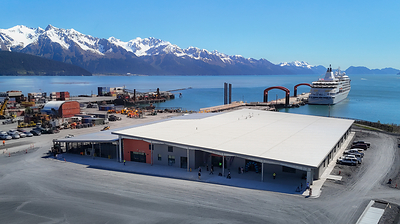
The Dale R. and Carol Ann Lindsey Alaska Railroad Terminal is a state-of-the-art facility that provides a seamless gateway to Alaska for guests around the world
SEWARD, Alaska, June 10, 2026 /PRNewswire/ -- Royal Caribbean Group (NYSE: RCL), a global vacation leader, recently commemorated the opening of the Dale R. and Carol Ann Lindsey Alaska Railroad Terminal with partners Alaska Railroad, The Seward Company, Turnagain Marine Construction at an official ribbon cutting ceremony including Alaska dignitaries Representative Louise Stutes of Kodiak and Seward, 5th District; Representative Alyse Galvin of Anchorage, 14th District; Alaska Department of Commerce, Community and Economic Development Commissioner Julie Sande; and Seward Mayor Sue McClure.
"We're thrilled to celebrate the culmination of nearly a decade of efforts to unlock this world-class travel destination, bringing long-term economic opportunities to Seward and beyond," said Josh Carroll, senior vice president, Deployment, Destination Development and Port Operations. "The journey to open the Dale R. and Carol Ann Lindsey Alaska Railroad Terminal as a portal to premier travel destinations would not have been possible without our supporting partners, government official stakeholders, and the local community."
The new terminal replaces aging dock facilities that date to the mid-1960s, positioning Seward as a premier cruise turn port.
"We know how important the terminal is not just to Seward, but to communities across Southcentral and Interior Alaska as these cross-gulf cruise guests take the opportunity to explore Alaska by land as well," said Bill O'Leary, President and CEO of the Alaska Railroad, the longtime owner and operator of the Seward passenger dock and terminal. "We were delighted to have the Lindsey family join us for the ribbon cutting to honor Dale and Carol Ann's many contributions to Seward and our state, and to celebrate an important milestone for this project."
As the largest cruise terminal in Alaska, this state‑of‑the‑art facility is designed to elevate guest experiences by prioritizing optimized passenger flows, sheltered queuing, and efficient passenger processing. The facility's direct adjacency to the Alaska Railroad station opens convenient onward travel to Anchorage, Fairbanks, and the broader communities of Alaska. The terminal is divided into 41,500 square feet of enclosed space and 27,000 square feet of open, pass-through luggage transfer layout.
The modernization of the pier includes a shore power system, developed through the US Environmental Protection Agency's Clean Ports Grant, resulting in cleaner air and reduced noise. With this alternative energy capability, any excess power generated during winter months will be stored in battery systems, serving as a backup power grid for Seward during unpredictable winter weather.
Built for year-round operations, the terminal serves as the community's largest indoor space, enabling ongoing recreational sports, concerts, festivals, and community gatherings, amidst winter weather conditions in the cruise off-season. The space was inaugurated for that exact purpose when Royal Caribbean Group invited the entire Seward community to help celebrate the culmination of their Port Partners small business accelerator program where standout business Exit Glacier Greenhouses received a $20,000 grant to help scale operations, representing the company's longstanding commitment to economic development in coastal communities.
See how Royal Caribbean Group is energizing communities around the world in our mission to vacation responsibly with the SEA The Future program.
Follow Royal Caribbean Group on social media:
LinkedIn: Royal Caribbean Group
Facebook: Royal Caribbean Group
X/Twitter: @RoyalCaribbeanGroup
ROYAL CARIBBEAN GROUP
Royal Caribbean Group is a leading global vacation company spanning cruise, one-of-a-kind destinations, and land-based vacation experiences. The company operates 70 ships sailing to more than 1,000 destinations across all seven continents through its three wholly owned brands - Royal Caribbean, Celebrity Cruises, and Silversea - and a 50% joint venture interest in TUI Cruises, which operates the Mein Schiff and Hapag-Lloyd brands.
The Group is expanding its portfolio of private destinations through its Perfect Day and Royal Beach Club collections, and the company will enter river cruising in 2027 with Celebrity River Cruises. Powered by innovative brands, advanced technology, and an industry-leading loyalty program, the company has built a connected vacation ecosystem, turning the vacation of a lifetime into a lifetime of vacations.
Named to the Fortune World's Most Admired Companies 2026 list and to Forbes' 2026 Best American Companies lists, Royal Caribbean Group is guided by its mission to deliver the best vacations responsibly. For more information, visit royalcaribbeangroup.com.

 View original content to download multimedia:https://www.prnewswire.co.uk/news-releases/royal-caribbean-group-and-alaska-railroad-company-celebrate-official-opening-of-cruise-terminal-in-seward-alaska-302796858.html

Der Asbest-Skandal rund um mehrere Steinbrüche im Burgenland entwickelt sich zu einer Milliardenbelastung für die öffentliche Hand. Nach einer neuen Berechnung der Umweltorganisation Greenpeace wird der materielle Schaden durch Entsorgung und Sanierung mindestens 1,6 Milliarden Euro betragen. Betroffen sind nicht nur das Burgenland, sondern auch Teile der Steiermark, Niederösterreichs sowie Gebiete in Ungarn, in die asbesthaltiges Material geliefert oder verbaut wurde.
Grundlage der Kostenschätzung ist die Annahme, dass seit 1990 rund 26 Millionen Tonnen asbesthaltiges Gestein aus vier Steinbrüchen abgebaut wurden. Greenpeace geht davon aus, dass etwa 20 Millionen Tonnen kurz- oder langfristig auf Asbestdeponien landen werden, während der Rest als Straßenunterbau, Fundamente oder in privaten Gärten in der Umwelt verbleibt und kaum mehr rückholbar ist. Rund 20 Prozent des Abfalls sollen in Form von asbesthaltigem Asphalt anfallen, dessen Deponierung besonders aufwendig ist und künftige Straßensanierungen über Jahrzehnte verteuern dürfte.
Mindestens drei Viertel der veranschlagten 1,6 Milliarden Euro entfallen laut Greenpeace auf die Entsorgung des Materials, der Rest auf Sanierungen. Für die Rechnung wurde ein Entsorgungspreis von lediglich 50 Euro je Tonne angesetzt – etwa die Hälfte des vor Bekanntwerden des Skandals üblichen Marktpreises. Diese Kalkulation sei nur zu halten, wenn rasch neue, sichere und kostengünstige Deponien errichtet werden, etwa in bereits geschlossenen Steinbrüchen, argumentiert Greenpeace. Andernfalls könnten sich die Gesamtkosten nach Einschätzung der Organisation auf mindestens das Doppelte erhöhen.
Die von Greenpeace genannten Summen übersteigen die Umsätze der betroffenen Steinbruchbetreiber deutlich und dürften auch die finanziellen Möglichkeiten des Landes Burgenland überfordern. Die Umweltorganisation drängt daher auf ein Eingreifen des Bundes und fordert, Mittel aus der Katastrophenhilfe bereitzustellen und einen Rahmen für eine kostengünstige Entsorgung zu schaffen. Zugleich verweist sie auf die Verantwortung des zuständigen Umweltministers, für ausreichend Deponiekapazitäten zu sorgen, um Kostenrisiken zu begrenzen und die logistisch aufwendige Räumung der asbestbelasteten Materialien langfristig planbar zu machen.