PARIS, June 11, 2026 /PRNewswire/ -- Orqa - Europe's leading developer and manufacturer of drones made without Chinese components - today announces the launch of the MRM2-10AI, a next-generation tactical drone purpose-built for contested battlefield environments and the realities of modern electronic warfare.
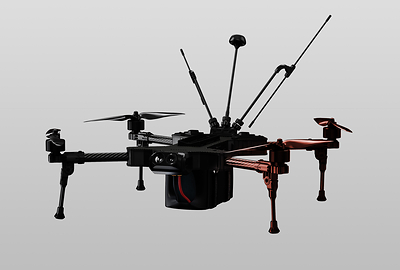
With armed forces increasingly facing radio-frequency jamming, GNSS disruption, and electronic attack, the MRM2-10AI sets a new standard in resilient communications, intelligent autonomy, and mission continuity, enabling it to succeed where conventional drone systems struggle.
At the heart of the platform is a hybrid communications architecture combining Orqa's proven IRONghost radio control system with native fiber-optic integration and automatic communications failover. This enables the MRM2-10AI to use either communication method without platform reconfiguration and instantly transition to the radio-frequency link if the fiber-optic connection is broken.
The MRM2-10AI features a powerful new Auto Pilot Board that unlocks a series of cutting-edge autonomous capabilities, including vision-based terminal guidance for GNSS-denied operations, advanced computer vision applications, battlefield analytics, and collaborative multi-drone operations.
A fully open development architecture and a supported third-party Developer Program (developer.orqafpv.com) provides a foundation for AI capabilities and software solutions, while ATAK compatibility supports seamless integration with existing battlefield management and situational awareness systems.
"As the nature of warfare continues to evolve, drone operators require systems that can remain effective in contested spaces," said Srdjan Kovacevic, co-founder and CEO of Orqa. "The MRM2-10AI combines resilient communications, onboard intelligence, and autonomous capability in a platform designed to keep missions moving. It represents the next step in tactical drone capability for today's armed forces."
Available in multiple configurations to meet a variety of mission requirements - including variants equipped with advanced thermal imaging and enhanced processing capabilities - the MRM2-10AI is being officially launched at Eurosatory 2026, the global event for defence and security in Paris.
 View original content to download multimedia:https://www.prnewswire.co.uk/news-releases/orqa-unveils-the-mrm2-10ai-at-eurosatory-a-tactical-drone-designed-to-dominate-in-the-age-of-electronic-warfare-302797302.html

Bei der Verleihung des BRICK AWARD 26 in Wien hat ein vietnamesisches Projekt den Ton für die internationale Ziegelarchitektur vorgegeben: Der Đạo Mẫu-Tempel mit angeschlossenem Museum wurde mit dem Grand Prize ausgezeichnet. Das Gebäude, das laut Veranstalter CO2-negativ errichtet wurde, setzt auf lokale Tonziegel und gilt als besonders ressourcenschonend. Die Gala in der österreichischen Hauptstadt zeigte, wie weit das Spektrum zeitgenössischer Keramikarchitektur inzwischen reicht – von religiösen Stätten in Asien bis zu Industrieanlagen in Lateinamerika.
Der BRICK AWARD wird seit 2004 alle zwei Jahre vergeben und versteht sich als herstellerunabhängige Plattform für Architekturbüros, die mit Ziegeln und Keramik arbeiten. Ausrichter ist der Baustoffkonzern Wienerberger, der mit dem Preis ein internationales Netzwerk von Pionieren der Ziegelarchitektur bündelt. Prämiert wird in fünf Kategorien: „Feeling at home“ für Einfamilienhäuser und kleinere Projekte, „Living together“ für städtische Wohnanlagen, „Working together“ für Gewerbe- und Industriebauten, „Sharing public spaces“ für öffentliche Gebäude und Räume sowie „Building outside the box“ für besonders innovative Ansätze.
Auf der Ebene der Einzelkategorien spiegelten die diesjährigen Gewinner zentrale Branchentrends wider. In der Kategorie „Feeling at home“ wurde ein offenes Einfamilienhaus auf Mallorca ausgezeichnet, das mithilfe speziell gesetzter Wände den Meerblick maximiert und zugleich Privatsphäre schafft. „Living together“ entschied ein gemischt genutztes Gebäude in Barcelona für sich, das nachhaltige Ziegel mit einem sozialen Innenhof kombiniert und damit auf dichte, aber gemeinschaftlich orientierte Stadtentwicklung setzt. In „Working together“ ging die Auszeichnung an ein Lager- und Bürogebäude in Mexiko, das lokale Keramik und vulkanisches Material integriert und so industrielle Nutzung und regionale Baustoffe verbindet.
Erstmals vergab die Jury zusätzlich einen Sonderpreis für innovatives gemeinschaftliches Wohnen. Dieser ging an ein Projekt in Belgien, das wiederverwendete Ziegel einsetzt, um eine nachhaltige Nachbarschaft zu schaffen. Der Fokus auf Recycling, CO2-Reduktion und lokale Materialien zieht sich damit durch zentrale Gewinnerprojekte des BRICK AWARD 26. Für Wienerberger, dessen Aktie zum Zeitpunkt der Meldung bei 22,71 Euro notierte, schärft die Auszeichnung zugleich das Profil als global vernetzter Akteur im Bereich Ziegel- und Keramiklösungen – mit dem nächsten Termin im Finanzkalender, der Quartalsmitteilung am 12. August 2026, bereits in Sichtweite.