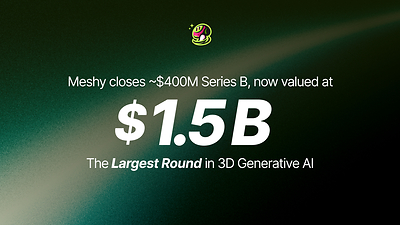
SILICON VALLEY, Calif., July 21, 2026 /PRNewswire/ -- Meshy, a company building foundation models for AI-powered 3D generation, today announced it has raised nearly $400 million in a Series B round at a $1.5 billion valuation. It is the largest funding round to date for a company built specifically for AI 3D. The round was backed by a group of leading global investors, with participation from all existing investors. It is also Meshy's first publicly disclosed valuation.
Meshy has made 3D creation dramatically simpler. From a single line of text or one image, users can generate a usable 3D model in about a minute. Work that once took specialized skills, expensive software, and weeks now takes about a minute and a dollar. As of July 2026, the company's annual recurring revenue is growing about 12x year over year, with more than 12 million registered users and over 100 million models created. In a field where most companies have yet to reach meaningful revenue, Meshy has built its lead on real commercial performance.
On the technology side, Meshy has advanced AI-generated 3D from "looking right on screen" to "ready for real production." Its models are usable directly in games and, increasingly, printable as physical objects - the company's core differentiator. Meshy is introducing several product updates:
Meshy's reach already extends to the very top of the global economy: five of the world's ten largest technology companies by market capitalization or valuation have teams building with Meshy. Meshy is also widely used across gaming, 3D printing, design, and the cultural sector. Its customers and partners include leading game companies such as Nexon, NetEase Games, and 37 Interactive Entertainment; top 3D printing brands including Bambu Lab, Creality, Elegoo, FlashForge, and xTool; and globally recognized names such as Hugo Boss and Sweden's museum of art and design.
That performance did not come from technology alone. Like many companies opening a new category, Meshy initially had to find the market its technology fit. As its models generalized and its understanding of users deepened, the company opened new use cases and revenue streams, turning a research lead into a durable commercial one.
Proceeds from the round will be used primarily for R&D and global market expansion.
Over the longer term, Meshy aims to lower the barrier to creation. The desire to create is innate to everyone: from the earliest paintings on cave walls to a video shot on a phone today, that impulse has never changed, only the difficulty of acting on it. Turning imagination into something real once demanded rare skill, costly tools, and significant time, and each advance in technology has made it easier.
Meshy is dedicated to unleashing that instinct in everyone, driving the gap between imagination and reality ever closer to zero. Today, anyone can generate a single 3D object on Meshy. In time, what people create will be an experience they can be immersed in, genuinely feel, and remember afterward. 3D is the starting point, and the domain in which Meshy has already proven its technology and built a real business. Extending that path further is the company's objective.
About Meshy
Founded by MIT PhD Ethan Hu, Meshy is on a mission to make 3D creation accessible to everyone, serving more than 12 million registered users worldwide. Learn more at meshy.ai.
 View original content to download multimedia:https://www.prnewswire.co.uk/news-releases/meshy-raises-nearly-400-million-at-a-1-5-billion-valuation-the-largest-round-to-date-in-ai-3d-302828413.html

Bei der Verleihung des BRICK AWARD 26 in Wien hat ein vietnamesisches Projekt den Ton für die internationale Ziegelarchitektur vorgegeben: Der Đạo Mẫu-Tempel mit angeschlossenem Museum wurde mit dem Grand Prize ausgezeichnet. Das Gebäude, das laut Veranstalter CO2-negativ errichtet wurde, setzt auf lokale Tonziegel und gilt als besonders ressourcenschonend. Die Gala in der österreichischen Hauptstadt zeigte, wie weit das Spektrum zeitgenössischer Keramikarchitektur inzwischen reicht – von religiösen Stätten in Asien bis zu Industrieanlagen in Lateinamerika.
Der BRICK AWARD wird seit 2004 alle zwei Jahre vergeben und versteht sich als herstellerunabhängige Plattform für Architekturbüros, die mit Ziegeln und Keramik arbeiten. Ausrichter ist der Baustoffkonzern Wienerberger, der mit dem Preis ein internationales Netzwerk von Pionieren der Ziegelarchitektur bündelt. Prämiert wird in fünf Kategorien: „Feeling at home“ für Einfamilienhäuser und kleinere Projekte, „Living together“ für städtische Wohnanlagen, „Working together“ für Gewerbe- und Industriebauten, „Sharing public spaces“ für öffentliche Gebäude und Räume sowie „Building outside the box“ für besonders innovative Ansätze.
Auf der Ebene der Einzelkategorien spiegelten die diesjährigen Gewinner zentrale Branchentrends wider. In der Kategorie „Feeling at home“ wurde ein offenes Einfamilienhaus auf Mallorca ausgezeichnet, das mithilfe speziell gesetzter Wände den Meerblick maximiert und zugleich Privatsphäre schafft. „Living together“ entschied ein gemischt genutztes Gebäude in Barcelona für sich, das nachhaltige Ziegel mit einem sozialen Innenhof kombiniert und damit auf dichte, aber gemeinschaftlich orientierte Stadtentwicklung setzt. In „Working together“ ging die Auszeichnung an ein Lager- und Bürogebäude in Mexiko, das lokale Keramik und vulkanisches Material integriert und so industrielle Nutzung und regionale Baustoffe verbindet.
Erstmals vergab die Jury zusätzlich einen Sonderpreis für innovatives gemeinschaftliches Wohnen. Dieser ging an ein Projekt in Belgien, das wiederverwendete Ziegel einsetzt, um eine nachhaltige Nachbarschaft zu schaffen. Der Fokus auf Recycling, CO2-Reduktion und lokale Materialien zieht sich damit durch zentrale Gewinnerprojekte des BRICK AWARD 26. Für Wienerberger, dessen Aktie zum Zeitpunkt der Meldung bei 22,71 Euro notierte, schärft die Auszeichnung zugleich das Profil als global vernetzter Akteur im Bereich Ziegel- und Keramiklösungen – mit dem nächsten Termin im Finanzkalender, der Quartalsmitteilung am 12. August 2026, bereits in Sichtweite.