SUZHOU, China, July 2, 2026 /PRNewswire/ -- Longsys (301308.SZ) announced the establishment of a stable monthly production and delivery capacity of one million mSSD (Micro SSD) units, marking a major milestone for its high speed mSSD storage solutions. The new production capacity is designed to meet growing market demand while providing room for future expansion.
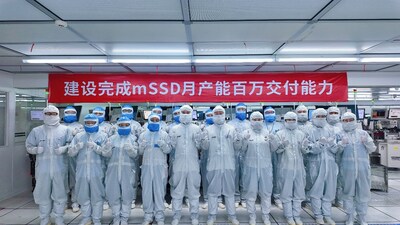
The first mSSD samples rolled off the production line at Longsys' Suzhou packaging and testing manufacturing base in October 2025. Following production line optimization, process refinement and manufacturing ramp-up, Longsys established a stable monthly production capacity of one million units in June 2026. Leveraging SiP (System-in-Package) integration and packaging technology to innovate and evolve traditional storage form factors, the product's performance, quality and functionality have been validated through real-world customer applications, and the company is now working with leading industry customers, including Lenovo and ASUS.
Longsys currently offers both PCIe Gen4 and PCIe Gen5 mSSD solutions. Designed with customized thermal architectures, the products deliver sustained high performance while maintaining a compact form factor for edge AI devices. The PCIe Gen5 version further incorporates a vapor chamber (VC) cooling solution to support higher bandwidth, larger capacities and improved sustained performance under intensive workloads.
Developed for AI PCs, intelligent terminals and other edge AI devices, Longsys mSSD adopts a System-in-Package (SiP) architecture that integrates the controller, NAND flash, power management IC and passive components into a single package. Compared with conventional PCB-based SSD designs, the SiP architecture simplifies manufacturing, improves space efficiency, enhances product reliability and shortens production cycles, enabling more efficient large-scale manufacturing and delivery.
Leveraging the fundamental advantages of its packaging architecture, this SiP integration solution is compatible with multiple generations of high-speed PCIe specifications — Gen4, Gen5 and the upcoming Gen6. It also delivers product development capabilities covering consumer-grade, industrial-grade and automotive-grade reliability standards.
To further strengthen its edge AI storage portfolio, Longsys introduced its proprietary SPU™ (Storage Processing Unit) together with iSA™ (Intelligent Storage Agent) and HLCache™ technologies in March 2026, creating an integrated hardware-software architecture for next-generation intelligent storage.
Looking ahead, Longsys will continue expanding its mSSD platform across AI PCs, AI Boxes and other edge AI devices while advancing the PCIe Gen5 ecosystem. By combining SiP integration with hardware-software innovation, the company aims to accelerate large-scale deployment of edge AI storage solutions and unlock the full commercial potential of integrated storage technology.
About Longsys
Founded in 1999, Longsys (301308.SZ) is a globally leading branded semiconductor memory enterprise, integrating R&D, design, packaging and testing, manufacturing, and sales services. For more information please visit https://www.longsys.com/, and follow Longsys on LinkedIn and Facebook.
Photo - https://mma.prnewswire.com/media/3003356/image1.jpg
 View original content:https://www.prnewswire.co.uk/news-releases/longsys-achieves-one-million-monthly-mssd-production-capacity-accelerating-edge-ai-storage-deployment-302816874.html

Bei der Verleihung des BRICK AWARD 26 in Wien hat ein vietnamesisches Projekt den Ton für die internationale Ziegelarchitektur vorgegeben: Der Đạo Mẫu-Tempel mit angeschlossenem Museum wurde mit dem Grand Prize ausgezeichnet. Das Gebäude, das laut Veranstalter CO2-negativ errichtet wurde, setzt auf lokale Tonziegel und gilt als besonders ressourcenschonend. Die Gala in der österreichischen Hauptstadt zeigte, wie weit das Spektrum zeitgenössischer Keramikarchitektur inzwischen reicht – von religiösen Stätten in Asien bis zu Industrieanlagen in Lateinamerika.
Der BRICK AWARD wird seit 2004 alle zwei Jahre vergeben und versteht sich als herstellerunabhängige Plattform für Architekturbüros, die mit Ziegeln und Keramik arbeiten. Ausrichter ist der Baustoffkonzern Wienerberger, der mit dem Preis ein internationales Netzwerk von Pionieren der Ziegelarchitektur bündelt. Prämiert wird in fünf Kategorien: „Feeling at home“ für Einfamilienhäuser und kleinere Projekte, „Living together“ für städtische Wohnanlagen, „Working together“ für Gewerbe- und Industriebauten, „Sharing public spaces“ für öffentliche Gebäude und Räume sowie „Building outside the box“ für besonders innovative Ansätze.
Auf der Ebene der Einzelkategorien spiegelten die diesjährigen Gewinner zentrale Branchentrends wider. In der Kategorie „Feeling at home“ wurde ein offenes Einfamilienhaus auf Mallorca ausgezeichnet, das mithilfe speziell gesetzter Wände den Meerblick maximiert und zugleich Privatsphäre schafft. „Living together“ entschied ein gemischt genutztes Gebäude in Barcelona für sich, das nachhaltige Ziegel mit einem sozialen Innenhof kombiniert und damit auf dichte, aber gemeinschaftlich orientierte Stadtentwicklung setzt. In „Working together“ ging die Auszeichnung an ein Lager- und Bürogebäude in Mexiko, das lokale Keramik und vulkanisches Material integriert und so industrielle Nutzung und regionale Baustoffe verbindet.
Erstmals vergab die Jury zusätzlich einen Sonderpreis für innovatives gemeinschaftliches Wohnen. Dieser ging an ein Projekt in Belgien, das wiederverwendete Ziegel einsetzt, um eine nachhaltige Nachbarschaft zu schaffen. Der Fokus auf Recycling, CO2-Reduktion und lokale Materialien zieht sich damit durch zentrale Gewinnerprojekte des BRICK AWARD 26. Für Wienerberger, dessen Aktie zum Zeitpunkt der Meldung bei 22,71 Euro notierte, schärft die Auszeichnung zugleich das Profil als global vernetzter Akteur im Bereich Ziegel- und Keramiklösungen – mit dem nächsten Termin im Finanzkalender, der Quartalsmitteilung am 12. August 2026, bereits in Sichtweite.