FREMONT, Calif., Sept. 29, 2026 /PRNewswire/ -- Leopard Imaging® will showcase its latest camera technologies and AI perception platforms at VISION 2026, taking place October 6–8, 2026, in Stuttgart, Germany.
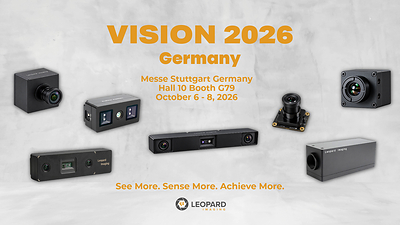
Visitors can meet the Leopard Imaging team at Hall 10, Booth 10G79, where the company will present a broad portfolio of live demonstrations for robotics, industrial automation, autonomous systems, machine vision, and edge AI applications.
Sirius Max with Lumotive LCM Technology – Long-Range 3D Perception
Sirius Max is a compact RGB + depth perception platform combining intelligent iToF depth sensing, programmable beam-steered illumination, and embedded synchronization. Designed for robotics and autonomous systems, the solution supports software-defined scanning and long-range 3D perception.
ASTRO Stereo Camera – High-Bandwidth RGB-IR Perception
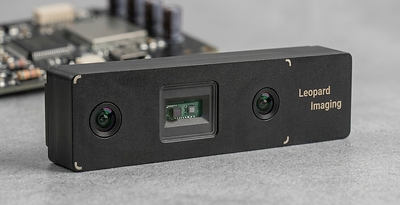
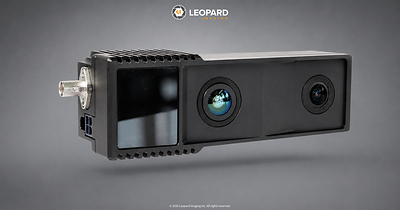
The ASTRO Stereo Camera integrates dual 5.1MP BSI global-shutter sensors, IR projection and illumination, and NVIDIA® Holoscan 10GigE connectivity. Demonstrated on the NVIDIA Jetson Thor platform, ASTRO supports synchronized RGB + IR stereo imaging, depth perception, 3D reconstruction, and AI perception pipelines.
IMX530 – High-Resolution Industrial AI Imaging
Built around the Sony 25MP IMX530 global-shutter sensor, this NVIDIA Holoscan 10GigE camera solution combines high-resolution imaging with FPGA processing for industrial inspection, barcode recognition, logistics automation, and other demanding machine vision applications.
Hybrid iToF RGB-D Camera – High-Precision Depth Sensing
The Hybrid iToF camera combines pulsed and phased indirect Time-of-Flight technologies with onsemi 1.2MP depth sensor. It is designed to provide high depth precision and reduced interference for robotics, 3D mapping, gesture recognition, and AR/VR applications.
IMX454 – Multispectral Imaging
The IMX454-based multispectral camera provides 41 spectral channels from 450 to 850 nm with 1948 × 1097 resolution at 30 FPS. The USB 3.0 UVC solution supports agriculture, food inspection, environmental monitoring, spectral analysis, and intelligent vision applications.
Dragonfly USB 3.0 YUV – 4K Camera with Integrated ISP
Dragonfly combines one onsemi 4K HyperLux LP sensor, integrated ISP, HDR imaging, and USB 3.0 connectivity. Its plug-and-play architecture is well suited for AI vision prototyping, smart kiosks, video conferencing, and industrial vision systems.
DragonFire – Real-Time Thermal Perception
DragonFire is an uncooled infrared camera delivering 640 × 512 resolution at 30/60 FPS with a 12 μm pixel size and NETD performance of ≤40 mK. Its GMSL2 interface supports robotics, industrial inspection, autonomous systems, and thermal monitoring applications.
Eagle 1 – RGB-IR Active Stereo Vision
Eagle 1 integrates two 5.1MP BSI global-shutter RGB-IR sensors, active IR illuminator, and a dot-pattern projector. The camera delivers RAW RGB and IR data for depth perception, intelligent navigation, robotics, and autonomous machines.
These demonstrations highlight our latest advances in AI perception. We welcome you to visit us to experience the technologies firsthand and meet our team.
About Leopard Imaging
Leopard Imaging is a global leader in AI perception and spatial intelligence solution design and manufacturing, delivering advanced imaging technologies for autonomous systems, robotics, AIoT, automotive, industrial automation, healthcare, and edge AI applications.
Media Contact
Leopard Imaging Marketing Team
Ariel Zhang
marketing@leopardimaging.com
 View original content to download multimedia:https://www.prnewswire.co.uk/news-releases/leopard-imaging-to-showcase-advanced-ai-perception-and-imaging-solutions-at-vision-2026-302891998.html

Der bewaffnete Juwelenraub im Wiener Museum für angewandte Kunst (MAK) vom 27. August ist nach Einschätzung externer Fachleute nicht auf Versäumnisse der Institution zurückzuführen. Ein 34 Seiten umfassendes Gutachten des Sicherheitsconsulting-Unternehmens LifeLine's kommt zu dem Schluss, dass das Haus sowohl bei den technischen Sicherheitsvorkehrungen als auch beim operativen Vorgehen während des Überfalls und im anschließenden Krisenmanagement korrekt gehandelt hat. Die zentrale Frage, ob das Ereignis sicherheitstechnisch und organisatorisch adäquat bewältigt wurde, beantworten die Gutachter mit einem „klaren Ja“.
Im Fokus der Untersuchung stand die Ausstellung „Glanzstücke. Van Cleef & Arpels High Jewelry x Masterpieces from the MAK Collection“, in deren Juwelenraum zwei bewaffnete Täter mitten am Nachmittag eine Vitrine einschlugen und mit einem historischen Diamantcollier flüchteten. Laut Bericht waren alle mit den Vertragspartnern vereinbarten Sicherheitsstandards und Normen erfüllt. Dazu zählten unter anderem der Einsatz von 185 Videokameras, einer dreistelligen Zahl von Alarmsensoren, speziellem Sicherheitsglas sowie geschultem Sicherheitspersonal. Der nach der Tat eingeführte Einsatz von Metalldetektoren war laut Gutachten zuvor weder verlangt noch durch bestehende Standards vorgesehen.
Besonders hervor hebt der Bericht die bewusste Entscheidung für den Vorrang des Personenschutzes vor dem Objektschutz. Aus diesem Grund verzichtete das Museum auf laute Alarmsignale während der Öffnungszeiten und auf bewaffnete Sicherheitskräfte im Ausstellungsbereich. Die direkte Alarmierung von Polizei und hauseigener Sicherheitszentrale wurde den Angaben zufolge um 14:01:22 Uhr ausgelöst und habe „optimal und effizient“ funktioniert. Auch das Verhalten der anwesenden Securitas-Mitarbeitenden wird positiv bewertet: Sie hätten eine unmittelbare Konfrontation mit den bewaffneten Tätern und damit das Risiko einer Eskalation, etwa durch Panik oder mögliche Geiselnahmen, vermieden.
Die Gutachter kommen insgesamt zu dem Befund, dass ein von professionellen Tätern geplanter und durchgeführter Raub unter regulären Öffnungsbedingungen mit „vernünftigen Mitteln“ nicht vollständig zu verhindern gewesen sei – selbst bei Einsatz moderner Überwachungstechnik und etablierter Sicherheitsprotokolle. Aus ihrer Sicht bestätigt der Fall eine bekannte Grenze musealer Schutzkonzepte: Absolute Sicherheit wäre nur um den Preis massiver Einschränkungen der Bewegungsfreiheit von Besucherinnen und Besuchern zu erreichen, formuliert das Gutachten sinngemäß. Das MAK wird damit für den konkreten Vorfall entlastet, auch wenn der spektakuläre Coup die Debatte über Sicherheitsstandards in Ausstellungshäusern neu anheizen dürfte.