BEIJING, Sept. 20, 2026 /PRNewswire/ -- JA announced that its independently developed and packaged P-type heterojunction (P-HJT) modules were successfully launched on September 17 and entered their planned orbit.
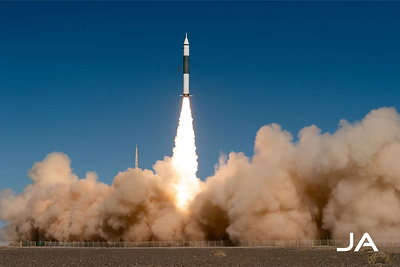
The mission marks JA's first in-orbit test of P-HJT modules, with future large-scale commercial applications as a long-term goal.
"Energy innovation has long been a driving force behind human progress," said Dr. Ouyang Zi, Chief Technology Officer of JA. "As satellite deployment accelerates and the space economy expands, solar power is expected to play an increasingly important role in future space infrastructure. Developing more cost-competitive solar solutions for space is therefore an important strategic priority.
"JA has spent years building expertise in photovoltaic technology, with the reliability and long-term performance of its products proven through large-scale manufacturing and deployment across a wide range of terrestrial applications. This in-orbit test extends those capabilities into the space environment and marks an important step in JA's exploration of future space energy solutions.
"Through real-world testing in orbit, we aim to assess the reliability and degradation of crystalline silicon technology in low-Earth orbit and explore more cost-competitive options for future space energy systems. The technology will require long-term validation, but we believe it is a direction worth pursuing."
In orbit, the JA modules will be exposed to harsh conditions, including intense radiation, high-energy particles and extreme temperature swings. By comparing in-orbit performance data with results from ground-based simulations, JA will assess the long-term reliability and degradation of P-HJT technology in low-Earth orbit.
If the validation targets are achieved, the program could help accelerate the adoption of mature crystalline silicon technologies as an alternative to gallium arsenide in low-Earth-orbit applications, potentially lowering the cost of satellite power systems. It could also support the development of satellite internet, remote sensing, space communications, space-based computing and other low-Earth-orbit applications.
JA will use the mission as a starting point to further strengthen its module R&D and manufacturing capabilities and advance scalable energy solutions for space exploration and commercial space applications.
Space PV remains at an early stage of exploration and validation, and large-scale commercialization remains highly uncertain. JA currently has no orders related to space PV, and the program has no material impact on its current operating performance.
 View original content to download multimedia:https://www.prnewswire.co.uk/news-releases/jas-space-pv-products-reach-orbit-starting-space-validation-302883945.html

Die Österreichischen Bundesbahnen (ÖBB) holen den Bahnhofskomplex Wien-Mitte nach rund zwei Jahrzehnten wieder vollständig in den eigenen Konzern zurück. Der Aufsichtsrat der ÖBB-Infrastruktur AG hat dem Rückkauf des Areals, das 2005 an die damalige BA/CA-Gruppe verkauft worden war, zugestimmt. Verkäufer ist nun eine Investorengruppe unter Führung von Morgan Stanley Real Estate Investing. Neben den Bahnanlagen umfasst die Transaktion auch das Einkaufszentrum "The Mall" sowie umfangreiche Büroflächen. Über den Kaufpreis wurde Stillschweigen vereinbart; der Abschluss steht noch unter dem Vorbehalt der kartellrechtlichen Genehmigung und ist für Ende Dezember geplant.
Mit der Übernahme würden Immobilie und Bahninfrastruktur erstmals seit mehr als zwanzig Jahren wieder in einer Hand zusammengeführt. Wien-Mitte ist gemessen an den Fahrgastzahlen der viertgrößte Bahnhof Österreichs und ein zentraler Verkehrsknoten, an dem sich S-Bahn, mehrere U-Bahn-Linien sowie der Flughafenzug CAT treffen. Täglich halten nach Angaben der ÖBB fast 600 Züge an dem Standort. Bahnanlagen und Gebäude seien baulich und technisch eng miteinander verbunden, heißt es. Künftige Änderungen an Zugängen, Stiegen, Belüftung oder Leitungen müssen damit nicht mehr mit einem externen Immobilieneigentümer abgestimmt werden.
Die ÖBB sehen in dem Rückkauf einen strategischen Schritt, um die Entwicklung des Standorts aus einer Hand zu steuern. Das soll zusätzlichen Handlungsspielraum für die kommenden Jahrzehnte schaffen, in denen die derzeit modernisierte S-Bahn-Stammstrecke mehr Züge aufnehmen soll. Die Funktion des Standorts als Bahnhof soll nach Angaben des Unternehmens wieder stärker im Namen, an den Zugängen und in der architektonischen Gestaltung zum Ausdruck kommen. Für die bestehenden Mietverhältnisse im Einkaufszentrum und in den Büros kündigte die ÖBB an, dass diese unverändert weitergelten.
Wien-Mitte blickt auf eine lange und wechselvolle Geschichte zurück. Der Standort wurde 1848 als Bahnhof Hauptzollamt eröffnet und ging 1934 in das Eigentum der Bahn über. Ab den späten 1950er-Jahren entstanden über den Gleisen unter anderem ein Bürotrakt und eine Markthalle, bevor die Liegenschaft 2005 veräußert wurde. Die spätere Entwicklung des Areals war von intensiven öffentlichen Debatten begleitet, unter anderem wegen geplanter Hochhäuser mit bis zu 97 Metern Höhe und der Diskussion um mögliche Auswirkungen auf den UNESCO-Welterbestatus. Mit der nun geplanten Re-Integration in den ÖBB-Konzern verknüpft das Unternehmen die Aussicht, die verkehrliche Rolle des Standorts und die bauliche Entwicklung langfristig aufeinander abzustimmen.