SEOUL, South Korea, Oct. 6, 2026 /PRNewswire/ -- HD Hyundai has delivered the world's first "Lashing-Free" container ship, introducing a new concept that eliminates the need for workers to manually secure containers on board.
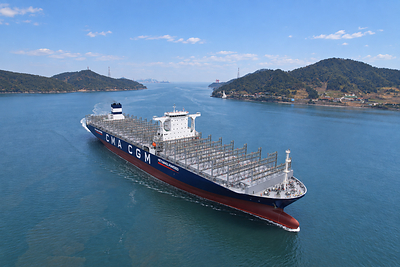
HD Hyundai announced on Tuesday, October 6, that it recently delivered a 13,000-TEU container ship for a French shipping company, with its hybrid-type Lashing-Free technology partially applied.
HD Hyundai Heavy Industries independently developed and validated all key components of the Lashing-Free technology, while HD Hyundai Samho was responsible for the detailed design and construction of the vessel incorporating the system.
The Lashing-Free container ship removes the need for manual container lashing, which has traditionally been carried out by workers using lashing equipment on large container vessels. It also incorporates technologies designed to prevent cargo loss and maximize logistics efficiency.
The vessel extends the cell guides, which support containers stacked vertically in alignment inside the cargo hold, all the way above deck.
With conventional large hatch covers, however, the extended cell guides would be obstructed, preventing them from reaching above deck. To overcome this structural limitation, HD Hyundai Heavy Industries developed a standardized portable bench that can be installed between the cell guides.
The portable bench is built to the same dimensions as a 40-foot container, allowing it to be handled using the same port cranes used to load and unload containers. The technology is expected to play a key role in accelerating automation and unmanned operations across the broader logistics network connecting land and sea, including container terminals.
HD Hyundai Heavy Industries has also developed a Twistlock Rooting System, which securely fastens containers stowed outside the cell guide area to the vessel's structure.
As a result, the Lashing-Free container ship can carry over 10% additional cargo weight on deck compared with conventional vessels of the same type. The system also provides stable support for containers even in rough seas and strong winds, helping prevent cargo loss, enhance maritime safety and reduce the risk of marine pollution.
Sea trials conducted by HD Hyundai in September showed that the Lashing-Free system significantly reduces vibration during operation compared with conventional designs using hatch covers and lashing bridges. The company is also developing a next-generation version of the technology incorporating weathertight features.
"We plan to expand the application of this new container transportation technology to small- and medium-sized vessels," said Hongryeul Ryu, Senior Executive Vice President and Chief Technology Officer at HD Hyundai Heavy Industries. "By continuing to develop differentiated technologies that deliver tangible value to customers in areas such as safety, loading efficiency and automation, we aim to further strengthen our ability to secure new orders."
Meanwhile, HD Hyundai Heavy Industries' Lashing-Free technology was introduced as a representative Korean technology related to "measures to prevent the loss of containers at sea" at the 10th session of the International Maritime Organization's Sub-Committee on Carriage of Cargoes and Containers (CCC) in 2024. The technology has secured multiple intellectual property registrations in Korea and overseas and was also selected as a recipient of this year's IR52 Jang Young-shil Award.

 View original content to download multimedia:https://www.prnewswire.co.uk/news-releases/hd-hyundai-delivers-worlds-first-lashing-free-container-ship-302899537.html

Die Österreichischen Bundesbahnen (ÖBB) holen den Bahnhofskomplex Wien-Mitte nach rund zwei Jahrzehnten wieder vollständig in den eigenen Konzern zurück. Der Aufsichtsrat der ÖBB-Infrastruktur AG hat dem Rückkauf des Areals, das 2005 an die damalige BA/CA-Gruppe verkauft worden war, zugestimmt. Verkäufer ist nun eine Investorengruppe unter Führung von Morgan Stanley Real Estate Investing. Neben den Bahnanlagen umfasst die Transaktion auch das Einkaufszentrum "The Mall" sowie umfangreiche Büroflächen. Über den Kaufpreis wurde Stillschweigen vereinbart; der Abschluss steht noch unter dem Vorbehalt der kartellrechtlichen Genehmigung und ist für Ende Dezember geplant.
Mit der Übernahme würden Immobilie und Bahninfrastruktur erstmals seit mehr als zwanzig Jahren wieder in einer Hand zusammengeführt. Wien-Mitte ist gemessen an den Fahrgastzahlen der viertgrößte Bahnhof Österreichs und ein zentraler Verkehrsknoten, an dem sich S-Bahn, mehrere U-Bahn-Linien sowie der Flughafenzug CAT treffen. Täglich halten nach Angaben der ÖBB fast 600 Züge an dem Standort. Bahnanlagen und Gebäude seien baulich und technisch eng miteinander verbunden, heißt es. Künftige Änderungen an Zugängen, Stiegen, Belüftung oder Leitungen müssen damit nicht mehr mit einem externen Immobilieneigentümer abgestimmt werden.
Die ÖBB sehen in dem Rückkauf einen strategischen Schritt, um die Entwicklung des Standorts aus einer Hand zu steuern. Das soll zusätzlichen Handlungsspielraum für die kommenden Jahrzehnte schaffen, in denen die derzeit modernisierte S-Bahn-Stammstrecke mehr Züge aufnehmen soll. Die Funktion des Standorts als Bahnhof soll nach Angaben des Unternehmens wieder stärker im Namen, an den Zugängen und in der architektonischen Gestaltung zum Ausdruck kommen. Für die bestehenden Mietverhältnisse im Einkaufszentrum und in den Büros kündigte die ÖBB an, dass diese unverändert weitergelten.
Wien-Mitte blickt auf eine lange und wechselvolle Geschichte zurück. Der Standort wurde 1848 als Bahnhof Hauptzollamt eröffnet und ging 1934 in das Eigentum der Bahn über. Ab den späten 1950er-Jahren entstanden über den Gleisen unter anderem ein Bürotrakt und eine Markthalle, bevor die Liegenschaft 2005 veräußert wurde. Die spätere Entwicklung des Areals war von intensiven öffentlichen Debatten begleitet, unter anderem wegen geplanter Hochhäuser mit bis zu 97 Metern Höhe und der Diskussion um mögliche Auswirkungen auf den UNESCO-Welterbestatus. Mit der nun geplanten Re-Integration in den ÖBB-Konzern verknüpft das Unternehmen die Aussicht, die verkehrliche Rolle des Standorts und die bauliche Entwicklung langfristig aufeinander abzustimmen.