Award-winning K3 features approximately 5-second nozzle swaps, up to 80% shorter print times, and expandable multi-material capabilities.
HOUSTON, Oct. 13, 2026 /PRNewswire/ -- Creality has officially opened pre-orders for the Creality K3, its latest flagship K Series 3D printer, starting at $849 in the United States. Recognized as an IFA Innovation Awards 2026 Honoree, the K3 introduces its proprietary four-nozzle KliTek™ system, designed to address two major challenges in multi-color 3D printing: lengthy color changes and excessive filament waste. Unlike conventional single-nozzle multi-color printers that repeatedly retract, reload, and purge filament, the K3 keeps four filaments ready in independent channels and switches between lightweight nozzle assemblies in approximately 5 seconds. The system delivers up to 80% shorter total print times and up to 85% less material waste compared with conventional single-nozzle multi-color workflows.
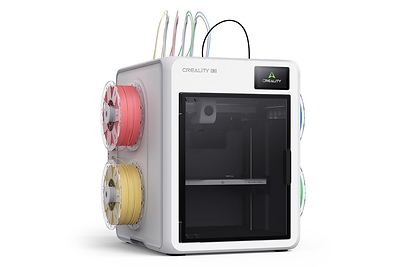
Four-Nozzle Innovation: Faster Printing, Less Waste
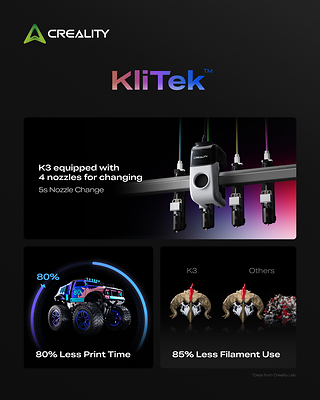
Traditional single-nozzle multi-color printing can involve hundreds or thousands of filament changes, significantly increasing production time and material consumption. Building on the automation and performance of the K2 Series, the K3 addresses this bottleneck with its proprietary KliTek™ nozzle-changing architecture.
With four independent filament paths, the system enables complete material changes in under 15 seconds and color switching up to five times faster than conventional workflows, reducing the repetitive purging associated with single-nozzle printing.
Beyond Multi-Color: Expanded Material and Creative Possibilities
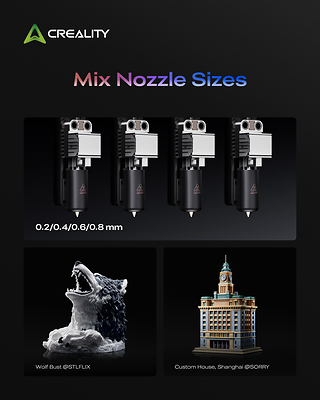
Beyond multi-color printing, the K3 supports advanced multi-material and mixed-nozzle applications through optional accessories.
Users can combine 0.2, 0.4, 0.6, and 0.8 mm nozzles within a single print, assigning smaller nozzles to detailed surfaces and larger ones to faster infill. This approach can improve printing efficiency by up to 30%.
For flexible materials, the S-Drive™ Dual-Drive feeding system supports TPU 85A–95A with compatible accessories, achieving flow rates of up to 15 mm³/s with TPU 95A, seven times that of standard consumer 3D printers under specified testing conditions.
The K3 also introduces CMYK physical color blending, using calibrated translucent filaments and controlled layer stacking to create a broader color spectrum. USB-C quick-swap nozzle assemblies further simplify maintenance, reducing replacement costs by up to one-third compared with complete toolhead replacements.
The printer supports common materials including PLA, PETG, PET, and PCTG, while optional accessories expand compatibility with engineering-grade, flexible, and soluble filaments.
High-Speed Performance with Precision and Reliability
The K3 features a 260 × 260 × 260 mm build volume, printing speeds of up to 500 mm/s, and acceleration of 20,000 mm/s². Its 300°C hot end and 100°C heated bed support a broad range of printing materials.
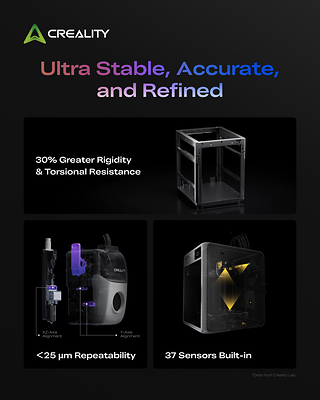
To maintain precision during rapid nozzle changes, the K3 integrates 37 sensors, including 12 dedicated to monitoring nozzle alignment and locking. In Creality's laboratory testing, the system maintained repeatability of less than 25 μm across more than 800,000 nozzle-change cycles.
The printer also features a reinforced structure with 30% greater rigidity, alongside a 7 dB reduction in operating noise, based on internal testing.
Pricing and Availability
The Creality K3 is now available for pre-order in the United States, starting at $849. From October 12 through November 30, 2026, customers purchasing the K3 for $849 will receive four complimentary rolls of Hyper PLA filament. Free shipping is also available for orders placed through Creality's official online store during the promotional period.
In Europe, the K3 is expected to become available in December 2026.
For more information or to pre-order, visit the Creality K3 official product page.
*Performance data is based on Creality's internal testing. Actual results may vary depending on materials, models, and printing conditions. Advanced multi-material, flexible-filament, and mixed-nozzle capabilities require optional accessories sold separately.
 View original content to download multimedia:https://www.prnewswire.co.uk/news-releases/creality-k3-opens-for-pre-order-at-849-advancing-multi-color-3d-printing-302906922.html

Die Festnahme des freien Journalisten Michael Bonvalot bei einer Versammlung in Steyr entwickelt sich in Österreich zu einem politischen Streitfall über das Verhältnis von Polizei, Demonstrationsrecht und Pressefreiheit. Bonvalot wollte nach eigenen Angaben am vergangenen Sonntag über einen „Aufmarsch der rechten Verschwörungsszene“ berichten, als er trotz gültigem Presseausweis von Einsatzkräften abgeführt wurde. Inzwischen ist ein Video des Vorfalls online, das die Debatte zusätzlich anheizt.
Steyrs Bürgermeister Markus Vogl (SPÖ) machte den Einsatz beim Sicherheitsgipfel mit der Polizei zum Thema und sprach von einem Vorgang, der „schwer zu verdauen“ sei. Nicht nur die Versammlungsfreiheit sei ein „hohes Gut“, betonte er, sondern ebenso die Pressefreiheit. Journalisten müssten bei solchen Einsätzen genauso geschützt werden wie Demonstrationsteilnehmer. Laut Vogl hatte Bonvalot aus rund 50 Metern Abstand berichten sollen und sich mit einem gültigen Presseausweis ausgewiesen.
Der Bürgermeister knüpfte seine Kritik an eine breitere Auseinandersetzung über die seit Jahren stattfindenden sonntäglichen Aufmärsche in Steyr. Diese sogenannten Spaziergänge, deren jüngste Ausgabe die 300. gewesen sein soll, hätten sich nach seinen Worten „bedauerlicherweise zu einer Anlaufstelle für demokratiefeindliche Gruppen“ entwickelt – mit prominenter Beteiligung von Szenefiguren wie Gottfried Küssel und Ken Jebsen. Während die Polizei bislang keine Gründe für ein Verbot dieser Versammlungen gesehen habe, entstehe nun der Eindruck, dass gegenüber einem Berichterstatter mit „zweierlei Maß“ gemessen werde. Vogl fordert von der Exekutive daher „vertrauensbildende Maßnahmen“; der Eindruck, polizeijuristische Einschätzungen gälten nicht für alle gleich, sei „untragbar“.
Innenminister Gerhard Karner (ÖVP) stellte sich demonstrativ hinter die Einsatzkräfte. Er verteidigte das Vorgehen der Polizei am Donnerstag als „verhältnismäßig und korrekt“ und widersprach damit der Darstellung, es handle sich um einen unverhältnismäßigen Eingriff in die Arbeit der Medien. Details zu der Einsatzbewertung blieben zunächst knapp, doch die veröffentlichten Videoaufnahmen dürften sowohl von Kritikern als auch von Befürwortern der Polizei genau analysiert werden. Während Vogl betont, er wolle trotz der guten bisherigen Zusammenarbeit mit der Polizei „nicht einfach zur Tagesordnung übergehen“, signalisiert das Innenministerium Rückendeckung für die Einsatzlinie vor Ort – ein Spannungsfeld, das die Diskussion über die Grenzen und den Schutz journalistischer Arbeit bei Demonstrationen weiter befeuern dürfte.