Outstanding Achievements for Global Well-Being and Our Shared Future
TAIPEI, Sept. 18, 2026 /PRNewswire/ -- The 2026 Tang Prize Award Ceremony brought together all six laureates in Taipei on September 18, with five receiving their awards in person and Biopharmaceutical Science laureate Dr. Steven A. Rosenberg taking part remotely. The laureates drew on decades of research, scholarship, and practice to address some of the most pressing challenges facing humanity and share their hopes for the future.
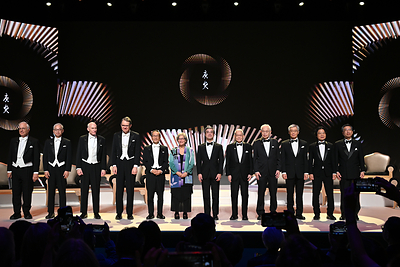
This year marked the first Tang Prize Award Ceremony since the passing of Tang Prize Founder Dr. Samuel Yen-Liang Yin, and a commemorative video was shown in his honor. Dr. Chung-Yao Yin, Chairman of the Tang Prize Foundation, said the framework and spirit established by his father will continue to be carried forward, and that the ceremony represents a continuation of the vision on which the Tang Prize was founded. Academician Chi-Huey Wong, President of the Tang Prize Selection Committee, said the selection committees for all four prize categories have consistently upheld objective, impartial, and professional standards in selecting laureates.
Professor Susan Solomon, the 2026 Tang Prize Laureate in Sustainable Development, noted that today's global environmental challenges may seem just as intractable as ozone depletion once did, but a combination of "science, public engagement, industry participation, and wise policy" enabled humanity to overcome that crisis. She expressed hope that humanity will once again succeed in "the moonshot of safeguarding our environment instead of destroying it."
Among the 2026 Tang Prize Laureates in Biopharmaceutical Science, Dr. Steven A. Rosenberg recalled that four decades ago, his team's work showed that tumor-infiltrating lymphocytes (TILs) derived from patients' tumors could mediate cancer regression, demonstrating that a patient's own lymphocytes could serve as a "living drug" against cancer. The work later led to therapeutic strategies using T cell receptors (TCRs) and chimeric antigen receptors (CARs). Rosenberg called it "a proud example of academic research" that led to lifesaving cancer treatments now available worldwide.
Dr. Michel Sadelain recalled that the idea of targeting CD19 with CAR T cells in the 1990s was rejected by most in academia and industry. He said the only way to advance the concept was to "do it yourself." His team treated its first patient in 2007, and the first CD19-targeted CAR therapies were approved by the U.S. Food and Drug Administration in 2017. Sadelain expressed particular gratitude to "the brave ones who risked their careers when this work was labelled 'science fiction.'"
Dr. Carl H. June said that for patients in the early clinical trials, the question was not whether CAR T-cell therapy was an elegant scientific idea, but whether it could give them more time: "Time with a spouse. Time to see a child grow up. For a child, time simply to grow up." He said patients and their families are "at the heart of this award" because they trusted the research team amid profound uncertainty. He added that whether a treatment reaches the people who need it must be part of how success is measured.
Professor Ge Zhaoguang, the 2026 Tang Prize Laureate in Sinology, noted that Sinology has become a global field of scholarship. Perspectives from different countries and regions are like mirrors held at different angles, together revealing a China that is nuanced and multifaceted. In his view, "the synthesis of East and West, together with pluralism and openness," is the path toward a flourishing field of Sinology.
Professor Bruce Ackerman, the 2026 Tang Prize Laureate in Rule of Law, reflected on growing up in one of New York City's most impoverished neighborhoods in the 1950s. His experience in public schools shaped by John Dewey's philosophy of progressive education encouraged him to explore alternative paths and think independently. At Harvard, he was deeply influenced by John Rawls. To this day, he continues to collaborate with colleagues in academia to explore the underlying sources of the worldwide crisis threatening the future of the rule of law.
Note: Livestream: https://youtube.com/live/DYKirmt37DI?feature=share
 View original content to download multimedia:https://www.prnewswire.co.uk/news-releases/2026-tang-prize-award-ceremony-honors-six-laureates-302883221.html

Der bewaffnete Juwelenraub im Wiener Museum für angewandte Kunst (MAK) vom 27. August ist nach Einschätzung externer Fachleute nicht auf Versäumnisse der Institution zurückzuführen. Ein 34 Seiten umfassendes Gutachten des Sicherheitsconsulting-Unternehmens LifeLine's kommt zu dem Schluss, dass das Haus sowohl bei den technischen Sicherheitsvorkehrungen als auch beim operativen Vorgehen während des Überfalls und im anschließenden Krisenmanagement korrekt gehandelt hat. Die zentrale Frage, ob das Ereignis sicherheitstechnisch und organisatorisch adäquat bewältigt wurde, beantworten die Gutachter mit einem „klaren Ja“.
Im Fokus der Untersuchung stand die Ausstellung „Glanzstücke. Van Cleef & Arpels High Jewelry x Masterpieces from the MAK Collection“, in deren Juwelenraum zwei bewaffnete Täter mitten am Nachmittag eine Vitrine einschlugen und mit einem historischen Diamantcollier flüchteten. Laut Bericht waren alle mit den Vertragspartnern vereinbarten Sicherheitsstandards und Normen erfüllt. Dazu zählten unter anderem der Einsatz von 185 Videokameras, einer dreistelligen Zahl von Alarmsensoren, speziellem Sicherheitsglas sowie geschultem Sicherheitspersonal. Der nach der Tat eingeführte Einsatz von Metalldetektoren war laut Gutachten zuvor weder verlangt noch durch bestehende Standards vorgesehen.
Besonders hervor hebt der Bericht die bewusste Entscheidung für den Vorrang des Personenschutzes vor dem Objektschutz. Aus diesem Grund verzichtete das Museum auf laute Alarmsignale während der Öffnungszeiten und auf bewaffnete Sicherheitskräfte im Ausstellungsbereich. Die direkte Alarmierung von Polizei und hauseigener Sicherheitszentrale wurde den Angaben zufolge um 14:01:22 Uhr ausgelöst und habe „optimal und effizient“ funktioniert. Auch das Verhalten der anwesenden Securitas-Mitarbeitenden wird positiv bewertet: Sie hätten eine unmittelbare Konfrontation mit den bewaffneten Tätern und damit das Risiko einer Eskalation, etwa durch Panik oder mögliche Geiselnahmen, vermieden.
Die Gutachter kommen insgesamt zu dem Befund, dass ein von professionellen Tätern geplanter und durchgeführter Raub unter regulären Öffnungsbedingungen mit „vernünftigen Mitteln“ nicht vollständig zu verhindern gewesen sei – selbst bei Einsatz moderner Überwachungstechnik und etablierter Sicherheitsprotokolle. Aus ihrer Sicht bestätigt der Fall eine bekannte Grenze musealer Schutzkonzepte: Absolute Sicherheit wäre nur um den Preis massiver Einschränkungen der Bewegungsfreiheit von Besucherinnen und Besuchern zu erreichen, formuliert das Gutachten sinngemäß. Das MAK wird damit für den konkreten Vorfall entlastet, auch wenn der spektakuläre Coup die Debatte über Sicherheitsstandards in Ausstellungshäusern neu anheizen dürfte.